Homepage » Products » Laboratory » Sample preparation ultrasound

Sample preparation with ultrasound ensures the validity of medical diagnostics

In clinical analysis and medical research, the quality of the measurement result is inextricably linked to the precision of the upstream processes. The Sample preparation is often the physical bottleneck: Whether it is the disruption of recalcitrant cell walls, the homogenisation of tissue biopsies or the preparation of solvents for high-performance liquid chromatography (HPLC) - ultrasound technology provides the necessary energy to transform samples for analysis in a deeply effective and absolutely reproducible manner. Without this controlled preparation, many analytes would remain trapped in the cellular structures and invisible to the detection systems.

Cavitation forces break cellular barriers at the molecular level

The main challenge in the processing of biological material such as bone fragments, fibrous tissue or stable bacterial cultures lies in overcoming highly resistant protective structures. While indirect sonication in a conventional ultrasonic bath is sufficient for simple suspensions or the cleaning of instruments, the complete extraction of DNA, RNA or proteins from complex matrices requires the concentrated energy of a sonotrode.

This process utilises acoustic cavitation. This creates microscopic vacuum bubbles every millisecond, whose implosion-like collapse releases extreme localised shear forces. These forces act like a mechanical scalpel on a molecular level:

Cell,Lysis,Destruction,Of,A,Cell,Can,Be,Used,To

Mechanical cell lysis:

The shock waves of cavitation break through cell walls and membranes directly. This releases the intracellular analytes into the medium without chemical additives contaminating the sample.

Salmon_Homogenising

Homogenisation of hard tissue:

Even mineralised samples or tough tendons, which can hardly be crushed manually, are converted into a homogeneous, analysable phase within seconds thanks to high amplitudes.

Indirect_sounding

Exclusion of cross-contamination:

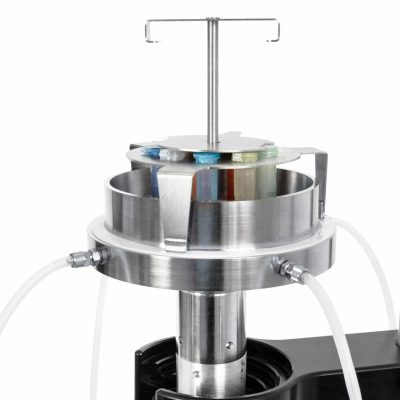
In medical diagnostics, purity is the top priority. Special accessories for sample preparation make it possible to work in closed disposable vessels (indirect sonication). This prevents any physical contact between the ultrasonic transducer and the patient sample.

TR100_with_HE

Increased throughput in the network:

Modern laboratories have to cope with high sample volumes. System solutions such as cup horns allow the simultaneous processing of numerous vessels with absolutely identical intensity, which guarantees the comparability of results within a test series.

Reproducibility guarantees the comparability of clinical data

A laboratory process is only scientifically reliable if it delivers identical results regardless of time and user. In diagnostics, it is crucial that sample preparation is subject to exactly the same physical conditions today as in three months' time. It is only through the digital control of parameters such as amplitude and sonication time that a process can be fully validated in terms of quality assurance (e.g. in accordance with ISO standards).

Thermal stability protects sensitive analytes

An unavoidable physical side effect of ultrasonic treatment is the energy input, which manifests itself as heat. Thermolabile substances such as enzymes, antibodies or fragile nucleic acid chains are at risk of irreversible denaturation if overheated. An uncontrolled rise in temperature would render the sample unusable for subsequent analysis. BANDELIN systems counter this risk with intelligent pulse management. Here, ultra-short sonication phases alternate with precisely defined pauses. The thermal energy generated can be dissipated during these intervals. In combination with external cooling media or specialised cooling vessels, the thermal load of the sample remains far below the critical denaturation threshold, while the mechanical digestion performance reaches its maximum. This allows even the most sensitive native proteins to be digested without loss of function.

Acoustic degassing stabilises the analytical baseline

An often underestimated but process-critical step in sample preparation is the complete removal of dissolved gases from eluents and solvents. In systems such as HPLC or capillary electrophoresis, the smallest air bubbles can lead to instabilities in the flow, noise in the baseline and distorted retention times. Treatment in an ultrasonic bath forces these gases to escape within a very short time. Compared to thermal degassing, the acoustic method is gentle on the solvent and does not change its composition by vaporising volatile components. The result is a highly stable analysis system that enables reproducible and therefore legally reliable diagnoses.

Physical principles of sound propagation in viscous samples

The effectiveness of the Sample preparation depends largely on the acoustic impedance of the medium. Viscous samples such as blood, mucus or concentrated gels attenuate the sound waves significantly more than aqueous solutions. As a result, the energy is absorbed in the medium instead of generating cavitation at the target location.

Professional ultrasonic homogenisers compensate for this effect by automatically adjusting the amplitude. If the resistance at the tip of the sonotrode increases due to a higher viscosity, the system increases the electrical power to such an extent that the mechanical amplitude remains constant. For laboratory staff, this means that they can rely on the preset energy actually reaching the depth of the sample, regardless of its consistency.

Sample quality ensures diagnostic authority

Modern medicine demands results that are not only available quickly, but are also absolutely reliable and repeatable. Sample preparation with ultrasound from BANDELIN transforms complex, often inhomogeneous starting materials into valid data sources for analysis. The combination of enormous mechanical force for cell disruption and sensitive process control to protect the analysed material makes ultrasonic technology an indispensable standard at the interface between patient sample and laboratory findings.

If you don't want to compromise on depth of examination and accuracy in diagnostics, you can rely on the physical superiority of controlled cavitation processes. Take advantage of our decades of expertise in medical research to raise your laboratory processes to a new level of validity.

Let us work together to define the optimum configuration for your specific sample matrices - request your individual application consultation now.

FAQ

With hard, fibrous or viscous material, the sonotrode delivers a precisely focussed energy density that is up to 100 times higher than in the bath. This force is necessary to mechanically separate stable cell clusters, which often remains incomplete with indirect sonication in the bath.
The precise amplitude selection and the pulse function are used to dose the mechanical load exactly in such a way that membranes break but long molecular chains are not fragmented. Simultaneous cooling also prevents thermal breaks in the phosphate backbone of the DNA/RNA.
Acoustic degassing removes dissolved gases faster and more thoroughly than simply leaving them to stand or heating them. This protects the sensitive equipment from gas bubbles in the pump head and ensures the repeatability of the measurement results.
By using disposable accessories and special holders for indirect sonication (e.g. cup horn), physical contact between the ultrasound transducer and the sample is completely avoided. This guarantees absolute purity for every single patient sample in shift operation.
Yes, by using flow-through cells, larger volumes can also be prepared while maintaining the amplitude parameters validated in the laboratory. This ensures that the sample quality remains stable regardless of the batch size.

Join us in

CONTACT

E-mail

info@bandelin.com

Give us a call!

+49 30 76880-0

Address

Heinrichstraße 3-4, 12207 Berlin

Bandelin Electronic

Quality since 1955

We - a Berlin-based family business in its third generation - specialise in the development, manufacture and distribution of ultrasonic devices, corresponding accessories and application-specific cleaning and disinfection preparations. The high vertical range of manufacture, a modern production facility and motivated employees distinguish us and are guarantors for constantly new quality products.

EN