Homepage » Applications » Ultrasonic cleaning of piercing accessories

Ultrasonic cleaning of piercing accessories: Legally compliant reprocessing in accordance with the Infection Protection Act and KRINKO

Anyone who runs a piercing studio using reusable tools finds themselves in a grey area when it comes to hygiene regulations: whilst the pliers and clamps are not technically classified as medical devices, the strictest standards under German hygiene law do, in practice, apply to their reprocessing. Anyone who underestimates this risks not only a formal complaint during the next inspection, but also the loss of their operating licence in the event of a repeat offence.

Not a medical device — yet still classified as Critical B

Piercing pliers and clamps are not covered by the EU Medical Devices Regulation (MDR 2017/745). To many business owners, this sounds like a relief. It is a trap. Because what matters is not the product category, but what happens with the instrument: during piercing, healthy skin is cut through. This is an invasive procedure — and public health authorities assess it during inspections in accordance with the KRINKO recommendations of the Robert Koch Institute. These are regarded as generally recognised rules of hygiene within the meaning of Section 36 of the Infection Protection Act (IfSG), regardless of the tool’s status as a medical device.

The result: piercing instruments with joints, grooves and blood contact fall into risk class ‘Critical B’ — a reprocessing category with more stringent requirements.

What Kritisch B is specifically calling for:

What the Infection Protection Act requires of gym operators

Section 36 of the IfSG requires businesses where services involve breaking the skin to comply with recognised hygiene rules. The competent authority is the local public health authority.

What the Public Health Authority specifically checks during inspections:

One point that is often underestimated: the Public Health Authority assesses not only the current state of affairs on the day of the inspection, but also the plausibility of the overall concept. A practice without an ultrasonic bath and without VAH-listed chemicals does not, by its very nature, have a valid reprocessing concept — even if the forceps look clean on the day of the inspection.

The right products for every application

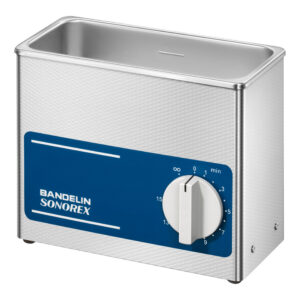
  • SONOREX SUPER RK 31 Ultrasonic bath Image

    SONOREX SUPER RK 31 Ultrasonic Bath

    388,00 € (plus Shipping & VAT) Commercial customers only

    excl. 19% VAT

    plus Shipping costs

    Add to basket
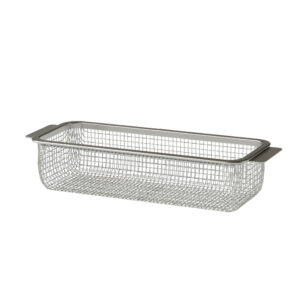
  • SONOREX K 08 hanging basket picture

    SONOREX K 08 insert basket

    48,00 € (plus Shipping & VAT) Commercial customers only

    excl. 19% VAT

    plus Shipping costs

    Add to basket
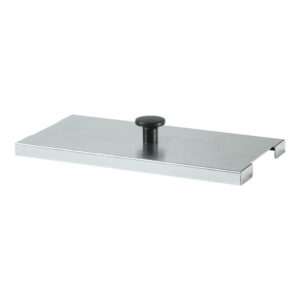
  • SONOREX D 08 Lid Image

    SONOREX D 08 lid

    26,00 € (plus Shipping & VAT) Commercial customers only

    excl. 19% VAT

    plus Shipping costs

    Add to basket
  • STAMMOPUR R Instrument Cleaner

    STAMMOPUR R Instrument Cleaner, concentrate

    25,00 € - 134,00 € (plus Shipping & VAT) Commercial customers only

    excl. VAT

    plus Shipping costs

    Select options This product has multiple variants. The options may be chosen on the product page
  • STAMMOPUR 24 Intensive cleaning and disinfection

    STAMMOPUR 24 Intensive cleaning and disinfection, concentrate

    102,00 € - 447,00 € (plus Shipping & VAT) Commercial customers only

    excl. VAT

    plus Shipping costs

    Select options This product has multiple variants. The options may be chosen on the product page

Why an autoclave alone is not enough

This is the most common mistake in day-to-day studio practice — and the most frequent point of criticism during inspections. An autoclave sterilises. It does not remove organic residues. Blood and wound exudate that adhere to the joints or ridges of piercing pliers after use are not dislodged by the heat — they are denatured and become firmly bonded to the material. The result is „sterile dirt“: no living germs, but biological residues that can trigger an inflammatory reaction the next time the instrument is used.

The ultrasonic bath solves precisely this problem: acoustic cavitation — millions of microbubbles that collapse under pressure — generates mechanical cleaning forces that dislodge organic material from joints, grooves and surfaces without physical contact. No manual brushing can achieve this effect in hard-to-reach areas.

The four-step validation process:

1.Ultrasound cleaning

SONOREX RK 31 + STAMMOPUR 24 (cleaning and disinfection in a single step, 2 %, 5 mins) or STAMMOPUR R (for pre-cleaning only)

2.Rinse

running tap water

3.Disinfection

VAH-listed preparation with a protein-dissolving effect (this separate step is not required if the combination preparation STAMMOPUR 24 has already been used)

4.Sterilisation

Steam sterilisation in an autoclave

VAH listing: Why not every cleaner is approved for ‘Critical B’

VAH-listed products have demonstrated their spectrum of activity under standardised conditions. For instruments that come into contact with blood, only products with protein-dissolving properties are suitable — because blood proteins significantly reduce the effectiveness of many disinfectants. Ordinary household cleaners or unlisted products are not permitted for this application. Anyone using them will be unable to demonstrate proper disinfection during an inspection — even if the instruments are subsequently autoclaved.

BANDELIN offers two complementary products:

STAMMOPUR 24

Cleaning and chemical disinfection in a single step, VAH-listed, protein-dissolving, 2 %, 5 mins

STAMMOPUR R

Pure cleaning concentrate for pre-treatment when disinfection is carried out separately

For multi-purpose studios, the following applies: TICKOPUR R 33 is suitable for tattoo equipment contaminated with colour pigments — but not as a disinfectant for instruments that come into contact with blood. Piercing and tattoo equipment should always be reprocessed in separate baths using the appropriate chemicals for each.

Common issues raised during site inspections — and how to avoid them

Buy SONOREX RK 31 now — the complete package for legally compliant data processing

Frequently asked questions about hygiene-compliant disinfection in piercing studios

Not directly — but in effect, yes. Section 36 of the IfSG requires compliance with the „generally recognised rules of hygiene“. The KRINKO recommendations are precisely that: the scientific consensus. Anyone who deviates from them must prove that their method is equivalent — which is virtually impossible to achieve in practice.

Three steps with different objectives, which are not interchangeable. Cleaning removes visible dirt. Disinfection reduces the bacterial count to a defined level. Sterilisation kills all microorganisms, including spores. Each step depends on the previous one: disinfection is ineffective on soiled instruments because organic material blocks the chemical action. Sterilisation is incomplete on instruments that have not been disinfected. The sequence is non-negotiable.

Yes. Section 36 of the IfSG requires businesses where the skin is broken as a result of the services provided to draw up and implement a written hygiene plan. This plan must specify the equipment, chemicals, concentrations and exposure times actually used, and must be updated regularly.

In the case of minor formal shortcomings, a period for rectification will be set. In the event of serious or repeated breaches, the public health authority may order a temporary closure. If a processing error can be linked to an infection in a customer, this will result in civil claims for damages and criminal consequences. The operator’s personal liability risk is considerable.

Yes. The ultrasonic method is described in the KRINKO guidelines as a recognised method for the mechanical pre-cleaning of instruments with complex geometries. This requires a device with a homogeneous sound field and defined performance parameters, as well as an approved cleaning agent at the prescribed concentration. Low-cost consumer devices without manufacturer validation are not suitable for the professional reprocessing process and are not accepted as evidence during an inspection.

The reprocessing requirements are waived entirely — but only if the instruments are declared by the manufacturer as single-use items and are in fact disposed of after a single use. Single-use items must not be reprocessed or reused. This would constitute a misuse of the item, which in turn would contravene hygiene legislation.

Only if it can be proven that it was delivered in sterile packaging and that the packaging remained intact right up until just before insertion. Jewellery without sterile packaging — even if new and unused — must be fully reprocessed: ultrasonic cleaning to remove manufacturing residues such as polishing pastes, followed by disinfection and sterilisation.

Join us in

CONTACT

E-mail

info@bandelin.com

Give us a call!

+49 30 76880-0

Address

Heinrichstraße 3-4, 12207 Berlin

Bandelin Electronic

Quality since 1955

We - a Berlin-based family business in its third generation - specialise in the development, manufacture and distribution of ultrasonic devices, corresponding accessories and application-specific cleaning and disinfection preparations. The high vertical range of manufacture, a modern production facility and motivated employees distinguish us and are guarantors for constantly new quality products.

EN